Enterprise AI Governance: Why Most Programs Stall in Year One

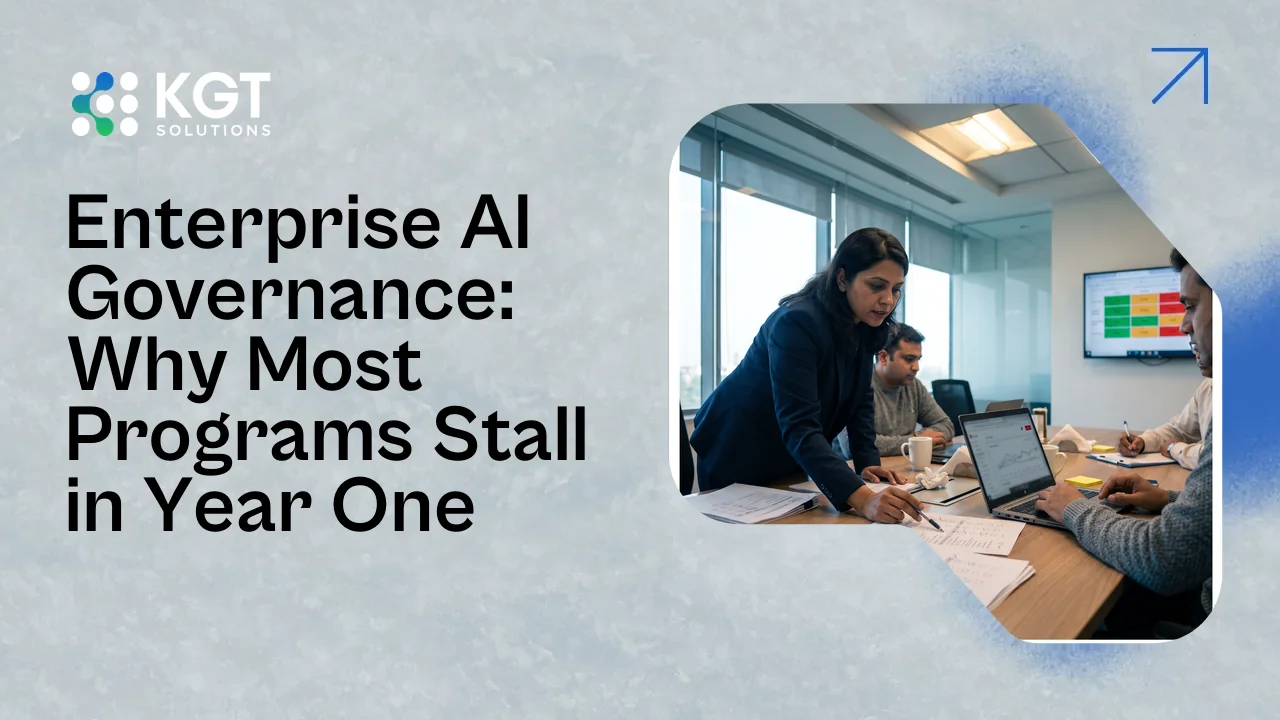
Enterprise AI governance stalls in year one because the policy gets written but nobody owns the audits, approvals, or model inventory.
You signed off on an AI policy last year. Then teams shipped six new tools, and nobody checked them against it. This guide shows where governance programs break after launch and how to keep them running.
Key takeaways:
Most governance programs fail at day-to-day operations after the policy is signed.
IBM found 63% of organizations had no AI governance policy or were still drafting one in 2025.
AI governance auditing works best as a quarterly loop with named owners.
Human validation belongs on high-risk decisions only, or reviewers burn out.
Agents need their own controls because they take actions on live systems.
What Enterprise AI Governance Covers in Practice
Enterprise AI governance covers who can build AI, which systems are allowed, how they're tested, and who answers when one fails.
Think of it like a building permit office. The rulebook matters, but inspections are what keep the roof up. Your AI policy is the rulebook, and governance is the inspection schedule.
Most programs use the NIST AI Risk Management Framework as a backbone. It groups the work into four functions: Govern, Map, Measure, and Manage. ISO/IEC 42001 adds a certifiable management system on top, which helps if customers ask for proof.
For the full framework build, our guide to an AI enterprise governance framework for CTOs walks through it. This post covers what happens after the framework ships.
Why AI Governance Challenges Pile Up in Year One
AI governance challenges pile up because AI use grows faster than review capacity, and shadow tools slip past every checkpoint.
McKinsey's 2025 State of AI survey found 88% of organizations use AI in at least one business function. That's a lot of systems for a three-person risk team to watch, and most of those teams were sized for a world with a handful of models.
The IBM Cost of a Data Breach Report 2025 shows what that gap costs. Among organizations that had an AI-related breach, 97% lacked proper AI access controls. Shadow AI added about $670,000 to the average breach bill.
We see the same failure points across almost every program:
No inventory. Nobody knows how many models, copilots, and AI vendors are live.
No owner. Legal wrote the policy, IT runs the tools, and nobody owns the gap between them.
One-time approval. A model passes review at launch, then drifts for 18 months without a second look.
Too many controls. Every low-risk chatbot gets the same review as a credit model, so teams route around the process.
AI Breaches Hit Hardest Where Governance Is Missing
What the IBM 2025 breach data shows about AI systems with weak oversight

How AI Governance Auditing Works
AI governance auditing checks real logs, outputs, and access records against your policy, not the slide deck that describes them.
A good audit answers three questions: is the system doing what it was approved to do, who touched it, and what changed since the last review?
Here's the order we use with clients:
Pull the inventory and confirm each entry has a named business owner.
Sample 50 to 100 recent outputs per high-risk system and score them against the approved use case.
Check access logs for service accounts and API keys that nobody can explain.
Compare the current model version and training data with what was approved.
Write findings with a due date and an owner, then track them to closure.
One edge case trips up almost everyone. A team fine-tunes an approved model on new data and calls it the same system. It isn't, and it needs a fresh review before release.
Step four catches more problems than you'd expect. Vendors swap model versions quietly, and your approval no longer matches what's running. Pair these reviews with AI model monitoring so drift shows up between reviews.
Where AI Governance Human Validation Fits
AI governance human validation means a named person reviews high-risk AI decisions before they reach a customer, patient, or ledger.
Human review is expensive, so spend it where mistakes hurt. Use an AI contextual governance framework that sets the review level by risk, not by tool type.
Risk tier | Example | Human validation |
|---|---|---|
Low | Internal meeting summaries | Spot check monthly |
Medium | Customer support drafts | Sample 5-10% weekly |
High | Credit, hiring, or safety calls | Review every decision before release |
Picture a lender that puts human review on every loan decision, including small top-ups. Within a month the queue could hit thousands of items. Approvals slow to a crawl, and staff start clicking through without reading.
The fix is to move small top-ups to weekly sampling. Reviewers then have time to read the high-risk cases properly.
The trap is rubber-stamping. If a reviewer approves 400 outputs a day, they've stopped reviewing. Cap the queue, rotate reviewers, and log every override so you can see where the model is weak.
AI Data Integration: Cutting Risk for Enterprise CTOs
AI Governance Continuous Improvement: The Quarterly Loop
The Quarterly AI Governance Loop
Four steps that keep enterprise AI governance current instead of frozen at launch
AI governance continuous improvement runs as a quarterly loop: inventory, classify, audit, then fix and report to a named risk owner.
Annual reviews are too slow for AI. Models update monthly, and new vendors show up every sprint. A quarterly cycle is short enough to catch drift and light enough that teams keep doing it.
Each loop should end with a one-page report. List new systems, tier changes, open findings, and anything that broke. If the report gets longer than a page, nobody reads it, and the loop dies.
Expect the first two loops to feel messy. Teams will find systems nobody remembers approving, and some people will argue about which tier a tool belongs in. That friction is the point, because it shows you where the policy is vague.
Track two numbers over time: the share of AI systems with a named owner, and the median days to close an audit finding. Both should move in the right direction every quarter.
Generative AI Governance, Agents, and Data Governance for AI
Generative AI governance adds controls for prompts, outputs, and agent actions on top of the data rules you already run.
People often ask about AI governance vs data governance. Data governance for AI decides what data a model may see, while AI governance decides what the model may do with it. You need both, and they should share one inventory.
Agents raise the stakes. A chatbot gives a bad answer, but an agent sends the email, books the refund, or changes the record. Gartner expects over 40% of agentic AI projects to be canceled by the end of 2027, with weak risk controls named as one cause.
An agentic AI governance framework should cover tool permissions, spending limits, action logs, and a kill switch. Test those limits before launch. Our post on agentic AI testing covers how.
What to Ask AI Governance Companies Before You Buy
AI governance companies sell inventory, monitoring, and audit tools, but no platform fixes a missing owner or a vague policy.
Buy software after you've run one manual audit cycle. You'll know what slowed you down, and you can judge vendors against that list.
Can it find shadow AI tools from network or SSO logs?
Does it map controls to NIST AI RMF, ISO/IEC 42001, and the EU AI Act?
Can it log agent actions as well as model outputs?
Will it export audit evidence your regulator or customer will accept?
The EU AI Act allows fines up to 35 million euros or 7% of global turnover for banned practices. That's the number to keep in mind when someone says governance can wait.
Frequently Asked Questions
What is enterprise AI governance?
How often should you audit AI systems?
What is the difference between AI governance vs data governance?
Do all AI systems need human validation?
What are the biggest AI governance challenges?
How is agent governance different from model governance?
Conclusion
Enterprise AI governance survives year one when every system has an owner, every quarter has an audit, and risk sets the review level.
Start small. Build the inventory this month, name an owner for each system, and run your first quarterly loop. Then decide which tools you need to buy. If you want a second pair of eyes on your current setup, the KGT team can review it with you.
Sources:
IBM - Cost of a Data Breach Report 2025
McKinsey - The State of AI 2025 Global Survey
NIST - AI Risk Management Framework (AI RMF 1.0)
ISO - ISO/IEC 42001:2023 AI Management System
Gartner - Agentic AI Project Cancellation Forecast, June 2025
European Union - Artificial Intelligence Act (Regulation (EU) 2024/1689)
Protocol AI Newsletter
Practical insights on AI, automation, and intelligent systems focused on real-world applications, not hype.