The Hidden Costs of Skipping Industrial Automation
The Hidden Costs of Skipping Industrial Automation

Most manufacturers who delay industrial automation think they're saving money. They see the upfront price tag on a PLC system or a robotic cell and decide to wait another year. What they don't see is the bill they're already paying.
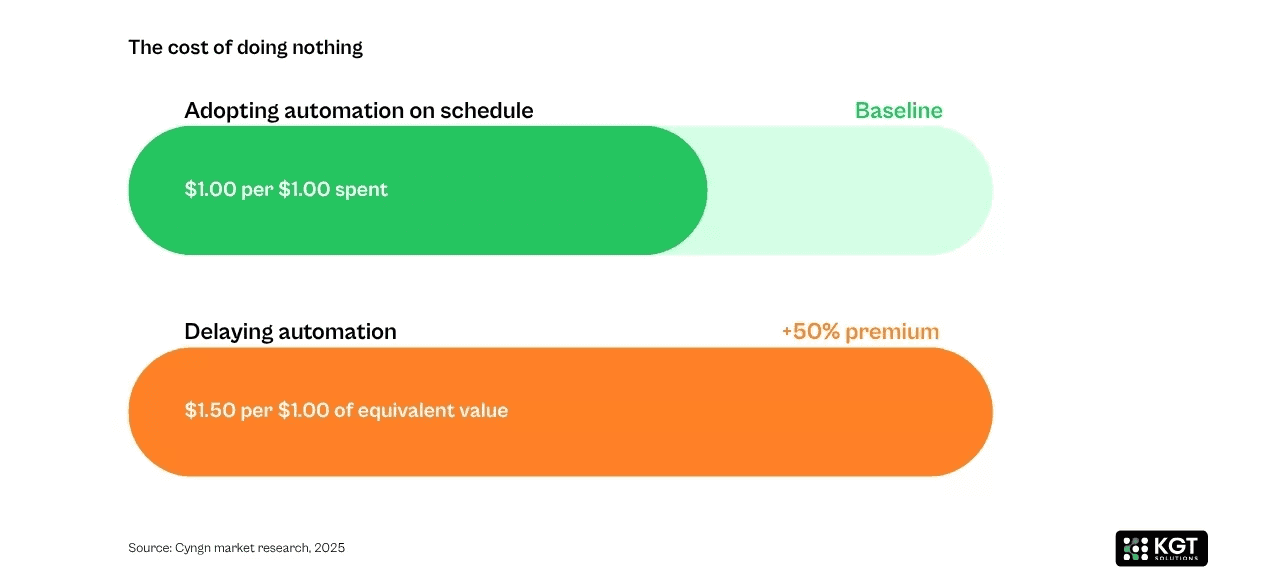
Skipping industrial automation doesn't eliminate costs. It hides them in downtime, turnover, scrap, and lost contracts. Research from Cyngn found that delaying automation carries up to a 50% cost premium over adopting it on schedule. That's not a rounding error. That's half again as much money leaving the business, quietly, every year.
The global industrial automation market hit roughly $221 billion in 2025, according to Mordor Intelligence, and is projected to reach $343 billion by 2031 at a 7.55% CAGR. Companies are spending at that rate for a reason. The ones that aren't are falling behind in ways that don't show up on a balance sheet until it's too late.
Where the money actually goes when you skip industrial automation
Where the money actually goes when you skip industrial automation
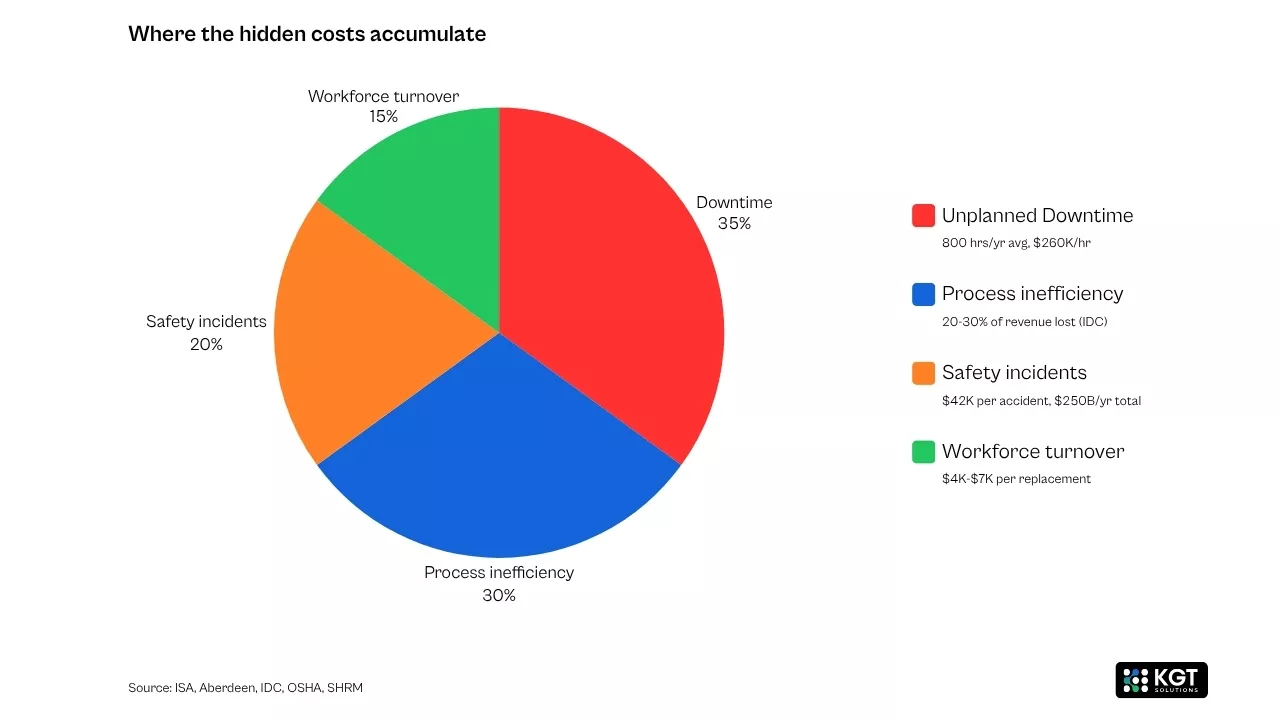
The International Society of Automation reports that the average manufacturer deals with 800 hours of unplanned downtime per year, about 15 hours a week. Aberdeen Group estimates that downtime costs $260,000 per hour on average. Run those numbers and you're looking at over $2 million a year vanishing into equipment failures that better industrial control systems and production monitoring systems could have flagged before they became emergencies.
A 2025 Schneider Electric study put finer numbers on this: closed, outdated automation systems cost mid-sized manufacturers 7.5% of annual revenue through downtime, inefficiency, and compliance retrofits. For large enterprises, the average loss was $45.18 million per year.
And those are just the direct mechanical costs. They don't account for what happens to people.
The workforce problem nobody budgets for
The workforce problem nobody budgets for
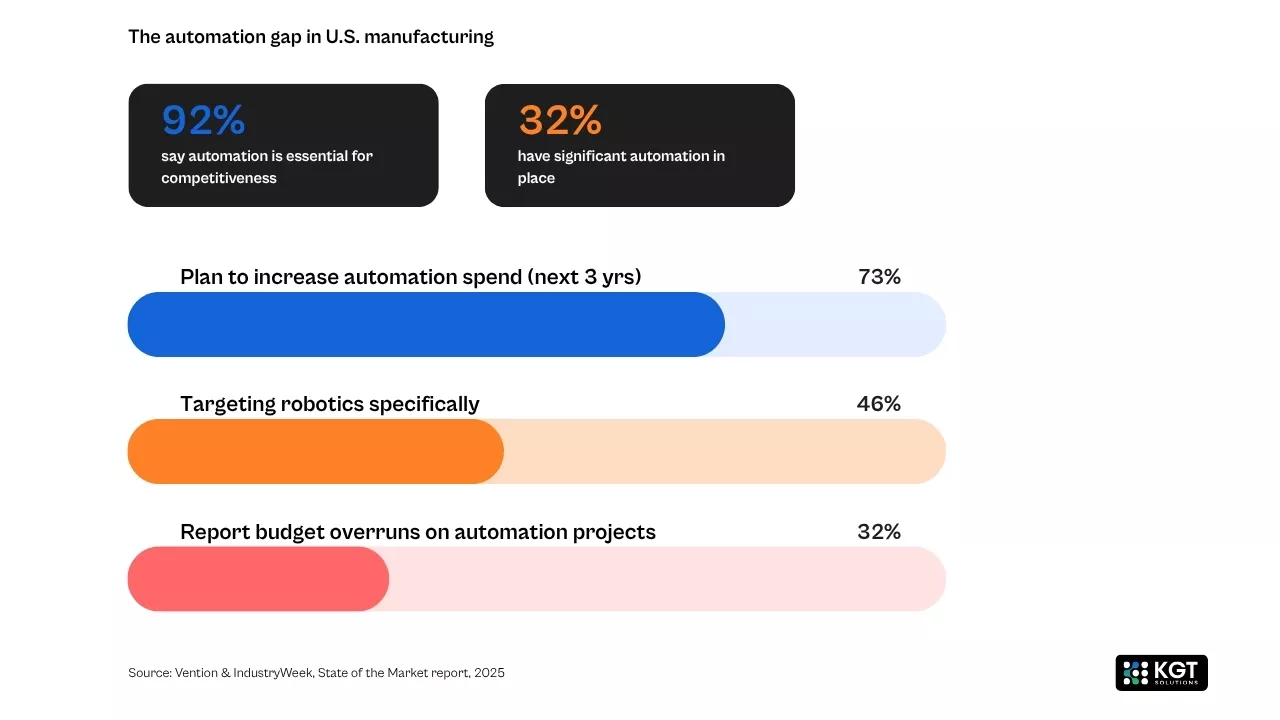
Here's something I keep coming back to: 92% of U.S. manufacturers agree that automation is necessary for long-term competitiveness, according to a 2025 Vention and IndustryWeek report. But only 37% have significant automation in place. That gap is doing real damage to their workforce.
Without automation PLC systems handling repetitive or hazardous tasks, workers get stuck doing the same monotonous operations every shift. They burn out. They leave. Then you spend $4,000 to $7,000 recruiting and training a replacement, according to SHRM estimates, only to watch the cycle repeat.
Warehouse automation and robotic process automation (RPA) services don't just cut labor costs. They change the kind of work people do. When a Wharton study looked at facilities that deployed autonomous vehicles, they found that improving work quality for existing employees increased retention rates measurably. People stayed because the job got better, not because the pay went up.
The U.S. Bureau of Labor Statistics has tracked a consistent decline in labor productivity in warehousing and storage every year since 2015. Hours worked keep rising, but output per hour keeps falling. That pattern is what happens when you throw more bodies at a problem instead of solving it with better systems.

Stop Guessing. Start Measuring.
See what downtime, energy waste, and manual processes are really costing your plant.
Stop Guessing. Start Measuring.
See what downtime, energy waste, and manual processes are really costing your plant.
Stop Guessing. Start Measuring.
See what downtime, energy waste, and manual processes are really costing your plant.
The quality and revenue you never realize you're losing
The quality and revenue you never realize you're losing
IDC estimates that inefficient processes cost businesses 20 to 30% of potential revenue annually. That number has always seemed abstract to me until I started looking at what it actually looks like on a factory floor.
Without production monitoring systems tied into industrial IoT solutions, you're running blind. You don't know when a machine is drifting out of tolerance until defective parts start showing up at inspection, or worse, at the customer. You waste material. You miss delivery windows. You lose contracts you never knew were at risk.
Industrial IoT development services connect machines, sensors, and control systems into a single network where problems become visible before they become expensive. Digital twin software takes this a step further, letting operators simulate changes before committing to them on the physical line, which reduces scrap, rework, and unplanned stoppages.
A 2025 report from Rockwell Automation noted that 93.4% of U.S. manufacturing firms have fewer than 100 employees. Many of them assume industrial automation products are out of reach. That assumption carries its own cost: these firms lose ground to competitors who figured out how to start small with modular, affordable systems.
Safety costs that compound silently
Safety costs that compound silently
The average industrial accident costs $42,000 in worker compensation alone, according to OSHA data. The U.S. saw over 5,486 fatal workplace injuries in 2022, per the Bureau of Labor Statistics. Over $250 billion gets spent on workplace injuries each year across all industries.
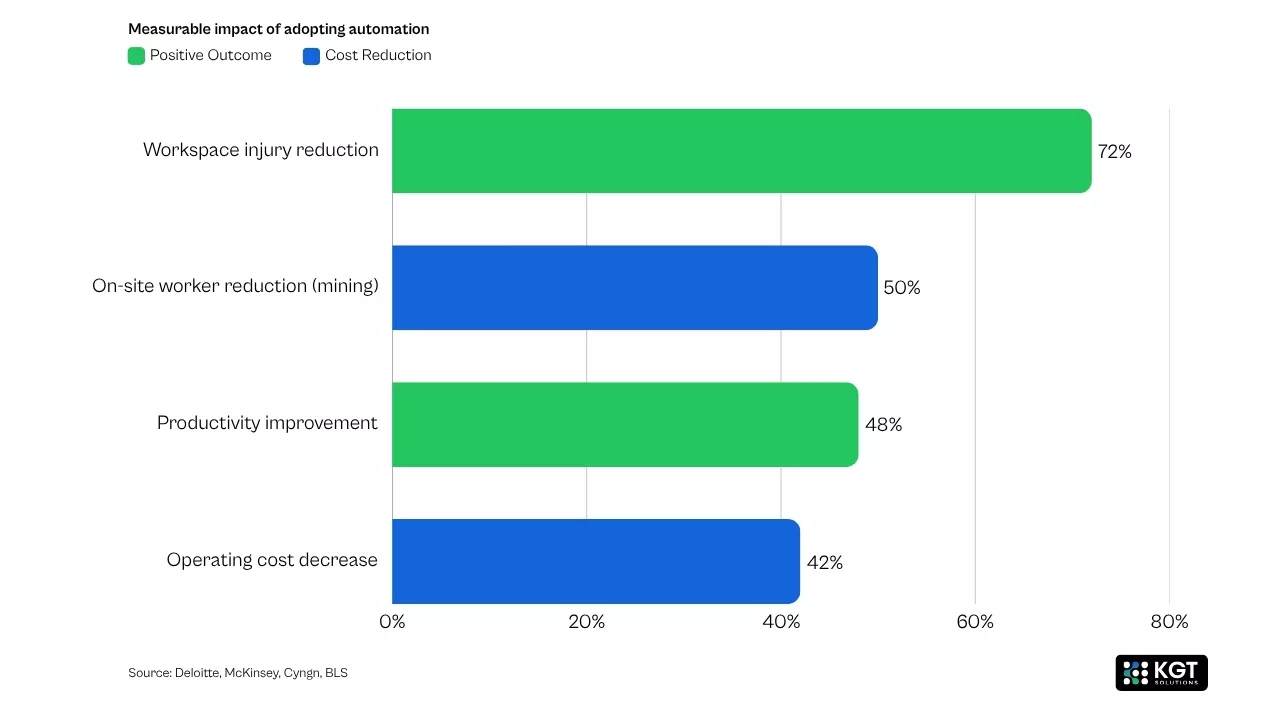
Industrial AI solutions and automation reduce injury exposure by removing workers from hazardous tasks entirely. Mining operations that adopted automation cut on-site worker requirements by more than 50%. Digital transformation technologies have been shown to reduce workplace injuries by 72% by keeping people away from the most dangerous parts of the operation.
These aren't aspirational projections. They're numbers from facilities that made the switch and measured the difference.
OEE Calculation: Formula, Examples and Where AI Helps
OEE Calculation: Formula, Examples and Where AI Helps

What actually changes when companies stop waiting
What actually changes when companies stop waiting
Deloitte and McKinsey found that performance analytics driven by automation produced a 20 to 70% productivity increase. Businesses that implement automation report up to a 48% improvement in productivity and a 42% decrease in operating costs, according to Cyngn's industry compilation.
The pattern is consistent: companies that invest, whether through PLC industrial automation, warehouse automation, or broader industrial control systems, recover their money faster than expected. In many cases, ROI appears within 12 months.
Meanwhile, 73% of manufacturers plan to increase automation spending in the next three years, and 46% are targeting robotics specifically. The competitive window for catching up is narrowing.
If you're still weighing whether the upfront cost of industrial automation is worth it, the data says you're already paying more by not doing it. The hidden costs of inaction, downtime, turnover, scrap, injuries, and lost revenue, don't wait for budget approval. They accumulate every day.
Frequently Asked Questions
What are the hidden costs of not automating industrial operations?
The hidden costs include chronic unplanned downtime averaging $260,000 per hour, escalating quality defects that erode customer trust, and rising labor costs from relying on manual processes in a tightening workforce market. Companies also lose competitive positioning as automated rivals deliver faster and more consistently. These costs compound silently and often exceed the investment required for automation.
How does skipping automation affect product quality over time?
Manual processes introduce human variability that causes inconsistent product quality, leading to higher defect rates, increased rework, and more warranty claims. Over time, these quality issues damage brand reputation and customer retention. Automated systems maintain precision tolerances consistently, eliminating the drift in quality standards that manual operations inevitably experience.
Can companies afford to delay automation if they are currently profitable?
Current profitability can mask the erosion happening underneath. Competitors investing in automation are steadily lowering their cost per unit and improving delivery times, which shifts market expectations. By the time declining margins become visible, the gap in operational capability may take years and significantly more capital to close.
What workforce risks come from avoiding industrial automation?
Manufacturers face a projected shortage of 2 million unfilled jobs by 2030, making reliance on manual labor increasingly unsustainable. Without automation, companies become vulnerable to absenteeism, high turnover, and rising wage pressures. Automation handles repetitive tasks while allowing existing workers to focus on higher-value roles that are easier to retain and recruit for.
What is the biggest misconception about the cost of industrial automation?
The biggest misconception is that automation requires massive upfront capital expenditure that only large enterprises can afford. Modern modular solutions, robotics-as-a-service models, and cloud-based industrial IoT platforms have made entry-level automation accessible to mid-size manufacturers. The real cost comparison should weigh automation investment against the ongoing losses from inefficiency, downtime, and quality failures.
Sources:
Cyngn, "Industrial Automation: The Cost of Doing Nothing" (2025) - cyngn.com
Mordor Intelligence, "Industrial Automation Market Report" (2026) - mordorintelligence.com
International Society of Automation, unplanned downtime statistics - isa.org
Aberdeen Group, cost of downtime estimates
Schneider Electric / Omdia, "Open vs. Closed: The $11.28 Million Question" (2025) - businesswire.com
Vention & IndustryWeek, "State of the Market" report (2025) - prnewswire.com
U.S. Bureau of Labor Statistics, warehousing productivity and workplace injury data
IDC, process inefficiency cost estimates
Rockwell Automation, "8 Key Industrial Automation Trends in 2025" - rockwellautomation.com
Deloitte & McKinsey, performance management analytics findings
Cyngn, "90+ Stats About Logistics, Manufacturing, and Automation" (2025) - cyngn.com
Industrial Autonomous Floor
Newsletter
Actionable insights on industrial AI, automation, and smart operations built for safe, secure, and compliant real-world environments.

