How does industrial automation upgrade your existing systems?
How does industrial automation upgrade your existing systems?
How does industrial automation upgrade your existing systems?

Industrial automation upgrades existing systems by layering programmable logic controllers, SCADA networks, and IIoT sensors onto legacy infrastructure, replacing manual checkpoints with closed loop control that cuts unplanned downtime by up to 30% and lifts overall equipment effectiveness above 85% without ripping out what already works.
Key takeaways:
Facilities that retrofit automation onto aging lines report 20-30% gains in throughput within 12 months, according to a 2026 Control Engineering survey of plant engineers and system integrators.
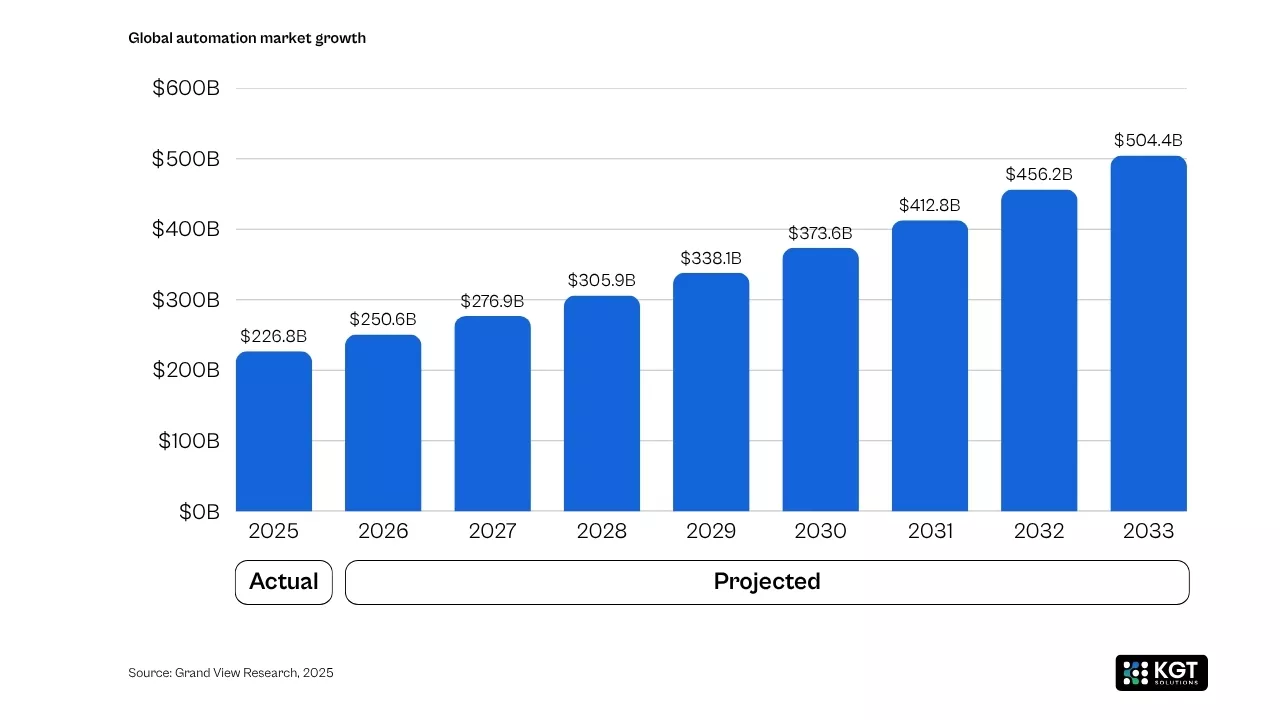
The global automation market hit $226.76 billion in 2025 and is forecast to reach $504.38 billion by 2033 at a 10.5% CAGR, meaning your competitors are already spending here (Grand View Research, 2025).
Edge AI controllers are the fastest growing segment at 14.88% CAGR, embedding real time analytics at the machine level for micro-stoppage prevention (Mordor Intelligence, 2026).
Most plant floors run on a patchwork of equipment bought over two decades. One bad sensor reading cascades into four hours of lost production, and nobody finds out until the shift report lands on your desk. This guide breaks down exactly how automation maps onto that patchwork, what it replaces, what it preserves, and what it costs per OEE point gained.
What does industrial automation actually replace in your current setup?
What does industrial automation actually replace in your current setup?
What does industrial automation actually replace in your current setup?
Industrial automation replaces manual data collection, paper based quality checks, and reactive maintenance routines with sensor driven, software orchestrated workflows that feed real time production data into a single control layer, so operations teams stop flying blind on shift performance.
"Automation" gets thrown around like it means one thing, but it does not. In a brownfield facility, the software layer sits between your existing PLCs and your MES or ERP. Nobody is asking you to trash your 2011 Siemens drives.
One beverage plant in western India kept its entire conveyor line, added vibration and flow sensors, and wired them into a new SCADA instance. They started seeing where bottles jammed before the operator could hear them. Line stoppages dropped 22% in the first quarter, same drives, different data.
The International Federation of Robotics reports 4.28 million industrial robots operational worldwide, a 10% year over year jump with annual installations topping 500,000 units for three straight years. The constraint is no longer robot availability, it is integration capacity on the factory floor.
Legacy infrastructure vs. automated production systems: what changes?
Legacy infrastructure vs. automated production systems: what changes?
Legacy infrastructure vs. automated production systems: what changes?
Automated production systems replace isolated machine islands with networked control loops where every actuator, sensor, and drive communicates through a unified protocol, slashing mean time to repair and turning maintenance from a calendar event into a data triggered action.
Factor | Legacy setup | After automation retrofit |
|---|---|---|
Data collection | Clipboard rounds every 2 hours | Continuous sensor feeds, 1 second intervals |
Downtime detection | Operator reports after the fact | Real time alerts via SCADA/HMI dashboards |
Quality assurance | End of line inspection, batch rejection | Inline vision systems, defect caught at source |
Maintenance model | Calendar based or breakdown reactive | Predictive, condition based via IIoT sensors |
Energy monitoring | Monthly utility bills | Per machine energy metering, load optimization |
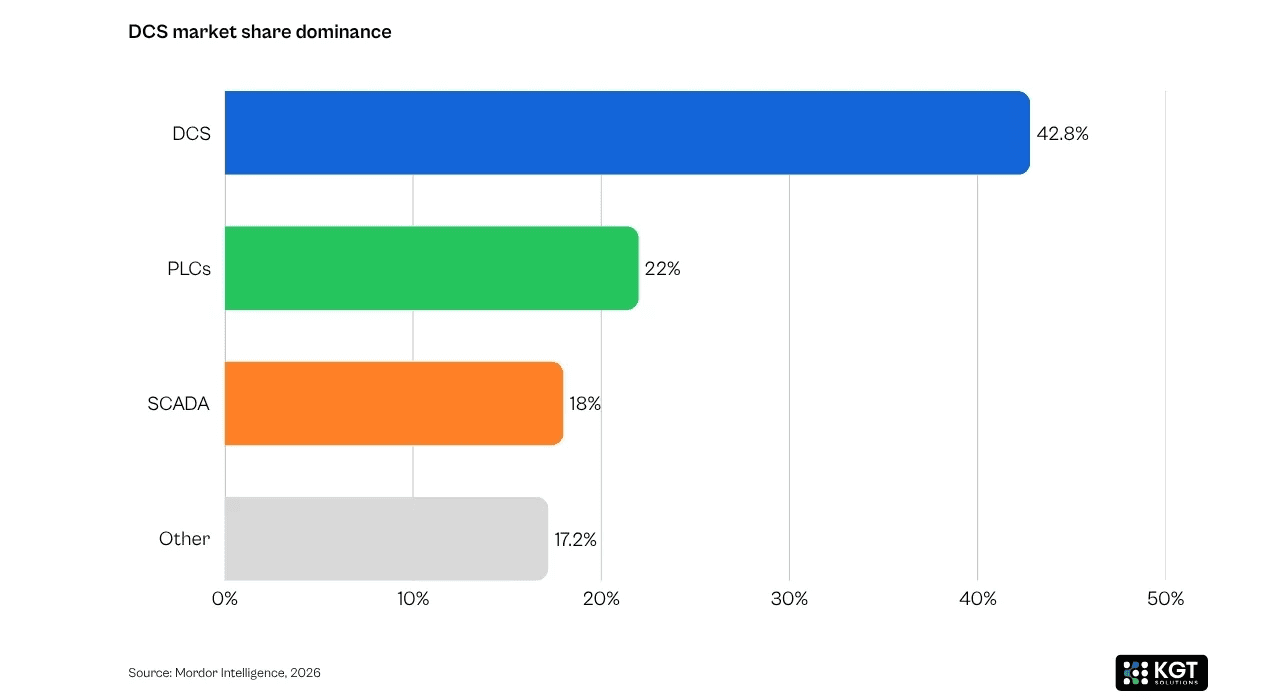
Mordor Intelligence pegs the automation services market at $166.56 billion in 2025, growing to $187.49 billion in 2026. Distributed control systems alone commanded 42.78% of that share because process industries treat them as mission critical infrastructure.

Stop Guessing. Start Measuring.
See what downtime, energy waste, and manual processes are really costing your plant.
Stop Guessing. Start Measuring.
See what downtime, energy waste, and manual processes are really costing your plant.
Stop Guessing. Start Measuring.
See what downtime, energy waste, and manual processes are really costing your plant.
How manufacturing process automation layers onto existing PLCs
How manufacturing process automation layers onto existing PLCs
How manufacturing process automation layers onto existing PLCs
Manufacturing process automation connects to existing PLC racks through industrial Ethernet or OPC-UA gateways, adding a supervisory data layer without rewriting ladder logic, so your proven control sequences stay intact while new analytics run on top.
The typical retrofit follows three steps:
Audit existing I/O points and communication protocols across all production cells.
Install edge gateways that translate legacy Modbus or Profibus signals into OPC-UA for the new automation technology stack.
Deploy an industrial automation and control systems platform (think Ignition, Siemens WinCC, or Aveva) that aggregates data and pushes dashboards to plant leadership in minutes, not days.
Roland Berger's 2026 automation update forecasts 6-7% CAGR through 2030, with value creation shifting from hardware to software. The ROI of industrial automation now depends more on how well your software layer reads the data than on how many robots you bought.
Why industrial IoT solutions accelerate the payback
Why industrial IoT solutions accelerate the payback
Why industrial IoT solutions accelerate the payback
Industrial IoT solutions accelerate payback by generating machine health data that enables predictive maintenance, which alone reduces unplanned downtime by 25-30% and extends asset life by 20%, according to McKinsey's 2025 manufacturing analytics benchmarks.
Every sensor you bolt onto a legacy motor or gearbox starts earning back its cost the first time it catches a bearing vibration pattern before failure. One food packaging operation installed 48 vibration sensors across a filling line for roughly $14,000. Six months later, those sensors had prevented two unplanned shutdowns worth an estimated $90,000 in spoiled product and overtime.
Industrial process solutions built on IIoT go beyond monitoring: temperature drifts trigger automated corrections, and pressure anomalies reroute flow before an operator even checks the HMI. The gap between raw sensor data and operational decisions is exactly where automation pays for itself repeatedly.
OEE Calculation: Formula, Examples and Where AI Helps
OEE Calculation: Formula, Examples and Where AI Helps

Frequently asked questions
Frequently asked questions
Frequently asked questions
Does upgrading to industrial automation require shutting down the entire plant?
Automation retrofits are staged cell by cell during planned maintenance windows, not as a full plant shutdown. Most integrators phase the work over 8-16 weeks, and you keep 70-80% of capacity running the entire time.
What is the typical ROI timeline for an automated factory retrofit?
Retrofits focused on predictive maintenance and OEE gains typically hit payback in 14-18 months. Plants with expensive unplanned downtime often break even faster because the retrofit kills the costliest failure modes first.
Can existing industrial automation products integrate with new IIoT platforms?
Existing industrial automation products running Modbus, Profibus, or EtherNet/IP connect to modern IIoT platforms through OPC-UA gateways. You keep the hardware that works, and the gateway handles the translation so new analytics layers can read the old signals.
Frequently Asked Questions
Can industrial automation be added to existing equipment without full replacement?
Yes, retrofit automation solutions like add-on sensors, IoT gateways, and modern PLCs can upgrade legacy equipment without replacing entire machines. This approach preserves your capital investment while unlocking real-time monitoring, predictive maintenance, and data-driven optimization capabilities.
What is the typical cost of upgrading versus replacing industrial equipment?
Upgrading existing systems with automation typically costs 20% to 40% of full replacement, making it the preferred first step for most plants. A controls retrofit on a legacy production line might cost $50,000 to $200,000 versus $500,000 to $2 million for a complete equipment replacement.
How long does it take to retrofit automation onto existing systems?
A focused retrofit project on a single production line typically takes 4 to 12 weeks depending on complexity and integration requirements. Planning and engineering take 2 to 4 weeks, installation happens during a scheduled shutdown, and commissioning runs 1 to 2 weeks before full production resumes.
What types of legacy equipment can be upgraded with modern automation?
Almost any industrial equipment with mechanical motion or process control can be upgraded, including CNC machines, conveyor systems, packaging lines, batch reactors, and HVAC systems. The key requirement is that the base mechanical structure is sound, even if the controls and instrumentation are outdated.
Will upgrading automation disrupt current production?
Smart upgrade strategies minimize disruption by staging work during planned shutdowns and running parallel systems during transition periods. Pre-built control panels and pre-programmed PLCs reduce on-site installation time, and phased rollouts let you upgrade one section at a time while the rest of the plant keeps running.
Conclusion
Pick your three worst performing lines. Map every manual touchpoint, price the downtime per incident, and build the business case from those numbers. That is where your first retrofit starts.
Conclusion
Pick your three worst performing lines. Map every manual touchpoint, price the downtime per incident, and build the business case from those numbers. That is where your first retrofit starts.
Conclusion
Pick your three worst performing lines. Map every manual touchpoint, price the downtime per incident, and build the business case from those numbers. That is where your first retrofit starts.
Sources:
Grand View Research, Industrial Automation and Control Systems Market, 2025
Mordor Intelligence, Industrial Automation Services Market Size and Growth, 2026
Roland Berger, Industrial Automation Update 2026
International Federation of Robotics via StartUs Insights, 2026 Industrial Automation Report
Control Engineering, 2026 State of Industrial Automation Report
Thunderbit, Automation Statistics 2026
Industrial Autonomous Floor Newsletter
Actionable insights on industrial AI, automation, and smart operations built for safe, secure, and compliant real-world environments.


