AI Powered Solutions to Evaluate Before You Buy


AI powered solutions range from $50/month chatbots to $5M custom systems - and picking wrong costs enterprises $2.3M on average.
Most enterprise CTOs start their AI evaluation with a 47-vendor spreadsheet. They end up more confused than when they started. The problem isn't a lack of options. It's a lack of clear criteria for what actually fits your stack, your data, and your team.
This guide gives you five evaluation filters that cut through vendor noise. You'll learn which tools fit specific business problems, where support AI delivers the fastest ROI, and when managed automation makes more sense than building in-house.
Key Takeaways
Five filters separate AI tools worth buying from expensive shelfware - here's what CTOs need to check first.
Enterprise AI tools fall into three tiers: point tools, platform plays, and custom builds
73% of enterprise AI projects fail because of poor vendor selection, not bad technology
Support-focused AI offers the fastest path to measurable ROI (avg 4-6 months)
Managed automation removes infrastructure overhead for mid-market companies
The build-vs-buy decision depends on your data moat, not your budget
Evaluation should test integration depth, not feature count
What AI Powered Solutions Actually Do for Enterprise Teams
Enterprise AI tools automate decisions, predictions, and pattern recognition across functions from supply chain to customer support.
That sounds simple. It isn't. The category now includes everything from $50/month chatbots to $5M custom computer vision systems. Enterprise spending on AI hit $232 billion in 2025, up 28% year-over-year according to Gartner.
But here's the part vendors won't tell you: 42% of companies that bought enterprise AI tools in 2024 aren't actively using them 12 months later. The technology worked fine. The fit didn't.
Three tiers exist in today's market:
Point tools: Single-function AI that does one thing well. Transcription, code review, email sorting. Low cost, low risk, limited impact.
Platform plays: Multi-function AI platforms that handle several workflows. Salesforce Einstein, Microsoft Copilot, and similar suites. Medium cost, medium integration effort.
Custom builds: AI systems designed around your specific data and processes. High cost, deep integration, highest competitive advantage.
Your tier choice matters more than your vendor choice.
Three Tiers of Enterprise AI Solutions
Cost, deployment time, and competitive impact scale with each tier. Your choice depends on your data moat and team capacity.
Single-function AI that does one thing well. Fast to deploy, low risk, limited competitive advantage.
Multi-function AI suites handling several workflows. Medium integration effort with broader business impact.
AI systems designed around your specific data and processes. Highest cost but strongest competitive moat.

Five Evaluation Criteria That Separate Good AI from Expensive Mistakes
Evaluation criteria for enterprise AI should test integration depth, data requirements, and time-to-value - not feature lists.
Most RFP processes focus on the wrong things. They ask "what can this tool do?" instead of "what will this tool do with our specific data?" Here's what to test instead:
Integration depth: Does it connect to your existing ERP, CRM, and data warehouse natively? API-only connections add 3-6 months to deployment timelines.
Data requirements: How much training data does the system need? Some tools work with 500 records. Others need 50,000.
Time-to-value: McKinsey found that AI projects averaging under 90 days to first value have a 68% success rate. Projects exceeding 12 months hit just 17%.
Total cost of ownership: License fees are 30-40% of the real cost. Add integration, training, maintenance, and the engineering time to keep it running.
Vendor lock-in risk: Can you export your trained models? If not, you're renting intelligence, not building it.
Criteria | What Vendors Show | What You Should Test |
|---|---|---|
Integration | "We connect to everything" | Run a proof-of-concept with YOUR data stack |
Speed | "Deploy in days" | Measure time from contract to first production output |
Cost | License fee only | Total cost including engineers, data prep, training |
Scale | "Handles millions of records" | Test with your actual data volume and complexity |
Support | "24/7 support" | Check average response time for technical issues |
Customer Service AI Tools: Where Most Companies Start
Customer service ai tools cut ticket resolution time by 40-60% and cost 70% less than adding headcount - making them the safest first AI bet.
There's a reason CTOs pick customer service first. The data is structured (tickets, chat logs, call transcripts). The metrics are clear (resolution time, CSAT, cost per ticket). And the ROI shows up in 4-6 months.
The best support AI platforms in 2026 handle three layers:
Tier 1 - Deflection: Chatbots and knowledge bases that resolve 30-45% of inbound questions without a human
Tier 2 - Agent assist: AI that suggests responses, pulls context, and automates follow-ups for human agents
Tier 3 - Predictive routing: Systems that match tickets to the right agent based on issue type, sentiment, and complexity
Intercom, Zendesk AI, and Ada handle Tiers 1-2 well for companies under 10,000 monthly tickets. But once your volume passes that mark, custom support AI built around your product data outperforms off-the-shelf options by 23% on first-contact resolution.
The mistake most CTOs make? Buying a Tier 3 tool when they haven't built a solid Tier 1 foundation. Start with deflection. Measure it. Then move up.
Intelligent Automation as a Service: The Middle Ground
Managed AI automation combines decision-making models with RPA execution, delivered as a service so you skip the infrastructure build.
Not every company needs to own its AI stack. And not every company should rent commodity tools. Managed automation sits between those two extremes.
Here's how it works. A provider bundles AI models (for predictions, classifications, or recommendations) with robotic process automation (for executing those decisions across your systems). You pay per process automated, not per seat or per API call.
Forrester reported that managed AI automation adoption grew 34% in 2025. The growth came mostly from mid-market companies with 500-5,000 employees. These companies don't have ML engineering teams. But they have complex processes that need AI.
The fit test is straightforward:
Factor | Build In-House | Managed AI Service |
|---|---|---|
Team size needed | 5+ ML engineers | 0-1 data analysts |
Time to deploy | 6-18 months | 4-8 weeks |
Upfront cost | $500K-$2M | $5K-$50K/month |
Data ownership | Full | Shared (check contracts) |
Customization | Unlimited | Moderate |
If your annual AI budget sits below $500K and you don't employ ML engineers, managed automation is almost always the right starting point.
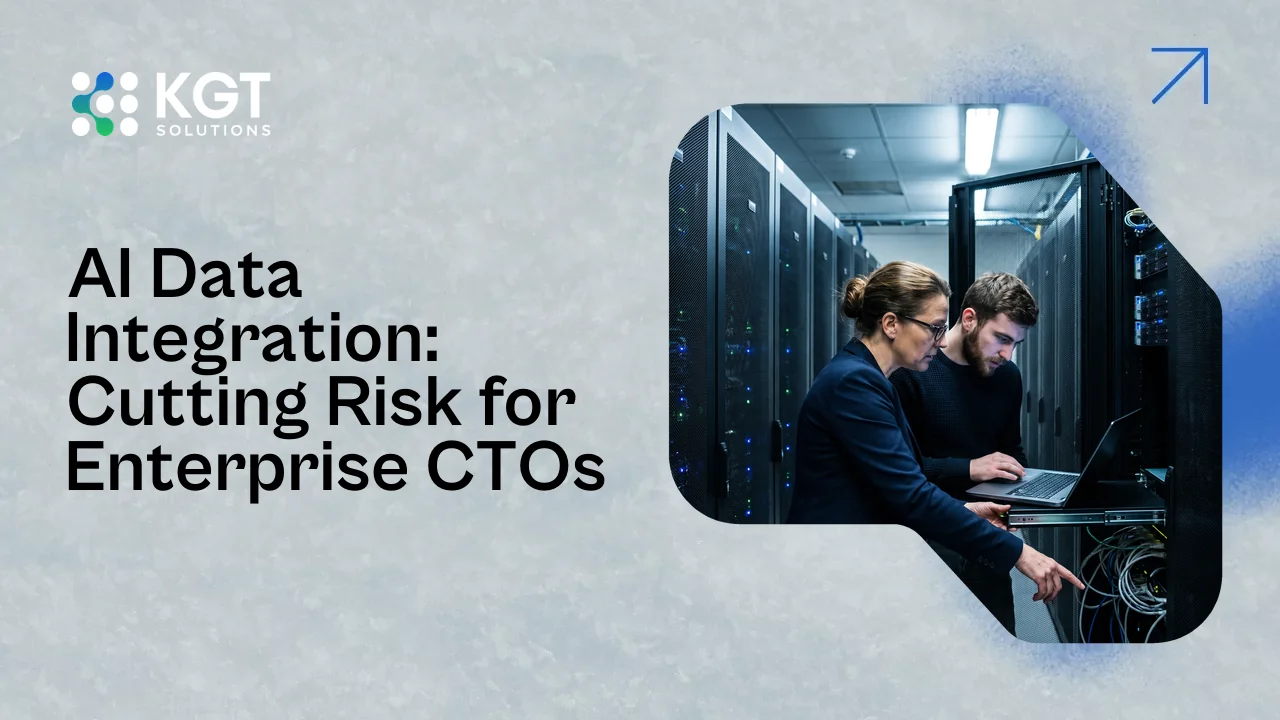
AI Data Integration: Cutting Risk for Enterprise CTOs
Build vs Buy: How CTOs Make the Final Call
CTOs should build AI when proprietary data creates competitive advantage and buy when speed-to-market matters more than differentiation.
The build-vs-buy decision for AI software comes down to one question: does your AI need to be different from everyone else's?
If you're automating invoice processing, buy. Dozens of tools handle this well. If you're building a recommendation engine trained on 10 years of proprietary customer behavior data, build.
When you choose an enterprise AI platform, start with the data question first. Where does your data live? How clean is it? Who owns the models trained on it?
Companies that evaluate AI consulting partners for hybrid approaches - buying the platform, customizing the models - report 2.4x faster deployment than pure-build teams.
Three signals that say "build":
Your competitive advantage depends on unique data that no vendor has access to
You need AI decisions to update in real-time based on proprietary feedback loops
You've already outgrown two off-the-shelf tools in this category
Three signals that say "buy":
The problem you're solving is common across your industry
Speed matters more than differentiation right now
Your ML team is smaller than three people
Common Mistakes When Choosing AI Powered Solutions
The biggest mistake CTOs make is optimizing for features instead of testing with production data.
Watch for these five patterns:
Demo bias: Every AI demo works perfectly. Ask for a proof-of-concept on YOUR data. Not the vendor's curated dataset. If they refuse, walk away.
Pilot purgatory: 61% of AI pilots never reach production according to Accenture. Set a 90-day kill switch before you start.
Integration theater: "We integrate with everything" means "we have an API." That's not the same as a working connector to your SAP or Oracle instance.
Ignoring change management: AI tools fail when people refuse to use them. Budget 20% of your project cost for training and adoption programs.
Chasing shiny features: The tools with the longest feature lists often have the weakest core performance. Pick the one that does your top three use cases exceptionally well.
Before you commit to building AI automation, pressure-test every assumption with real data and real users. The best AI investment is the one your team actually adopts.
Frequently Asked Questions
What are the best enterprise AI tools for mid-to-large companies in 2026?
How much do enterprise AI tools cost for mid-market companies?
What's the difference between standalone AI tools and managed automation?
How long does it take to deploy enterprise AI tools?
Should CTOs build or buy their AI stack?
What's the fastest way to see ROI from enterprise AI?
Conclusion
Choosing the right ai powered solutions requires testing with your own data, matching the tool tier to your team size, and setting hard deadlines on pilots.
The AI market will keep growing. Vendors will keep making promises. Your job as a CTO isn't to find the "best" AI tool. It's to find the one that fits your data, your processes, and your team's ability to adopt it. Start with support AI if you need a quick win. Consider managed automation if you're resource-constrained. And build custom only when your data gives you a genuine edge that no vendor can replicate.
Sources
Gartner - Enterprise AI Spending Report 2025
McKinsey & Company - The State of AI in the Enterprise 2025
Forrester Research - Intelligent Automation Market Analysis 2025
Accenture - AI Pilot-to-Production Success Rates Study
MIT Sloan Management Review - Why AI Projects Fail
IDC - Worldwide AI and Automation Spending Guide 2025
Protocol AI Newsletter
Practical insights on AI, automation, and intelligent systems focused on real-world applications, not hype.