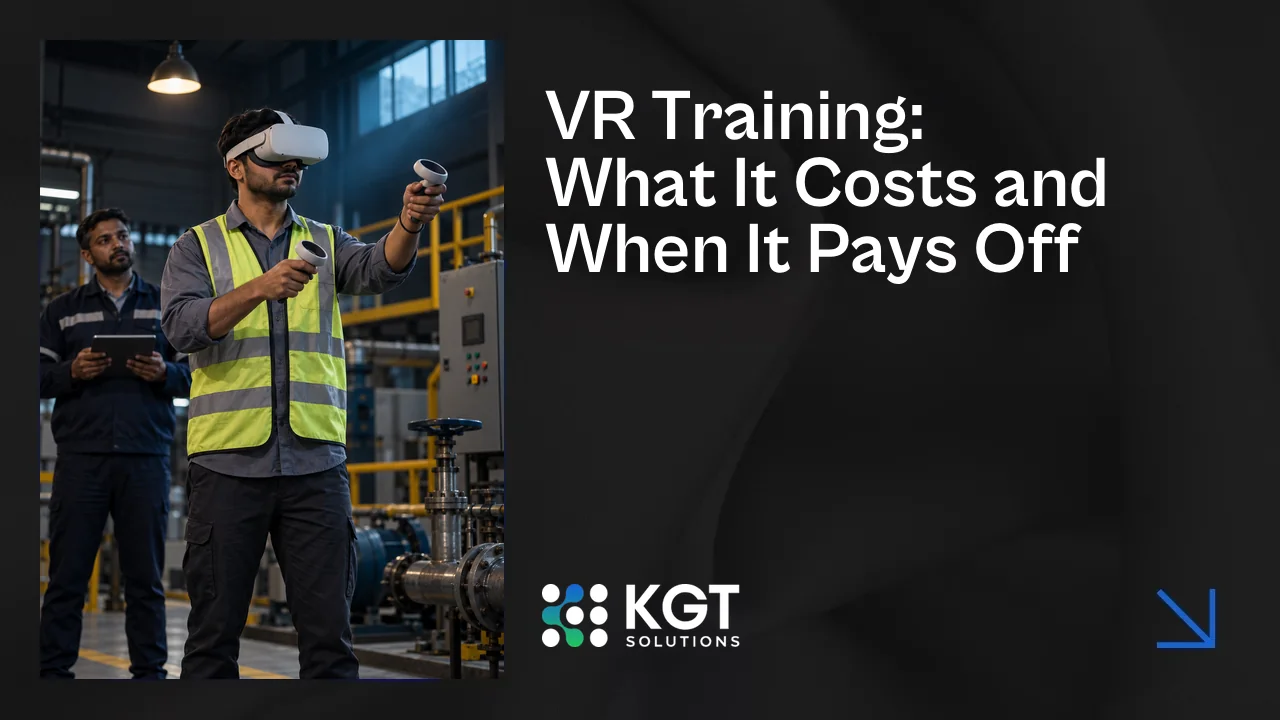
VR Training: What It Costs and When It Pays Off

VR training pays off when you train 375+ people a year on skills that are costly, rare or risky to practise on real equipment.
Key Takeaways
VR training beats classroom on cost only past a volume threshold, and it works best for hands-on and high-risk skills.
PwC found VR learners trained up to 4x faster than classroom learners in its 2020 enterprise study.
In the same study, VR reached cost parity with classroom at 375 learners and became 52% cheaper at 3,000.
Walmart has trained more than 1 million associates with VR headsets across its US stores.
A custom VR module usually costs $30K-$150K to build, depending on interaction depth.
VR is a poor fit for content that changes monthly or that a 5-minute video teaches just as well.
You're spending weeks onboarding new hires, and much of the practice happens on machines you can't afford to stop. A headset lets people practise on a virtual copy, as many times as they need.
This guide gives you the real cost drivers, the break-even math and the cases where VR is the wrong call.
What Is VR Training?
VR training puts learners in a headset inside a 3D copy of their workplace, where they practise tasks by doing them.
Think flight simulator, scaled down to a standalone headset that costs a few hundred dollars. A new operator can run a machine start-up sequence 20 times before touching the real panel. A mistake costs a restart, not a damaged motor or an injury.
VR training programs usually cover four kinds of skill:
Equipment operation: start-up, shutdown and changeover steps.
Safety drills: lockout/tagout, confined space entry and fire response.
Maintenance: fault finding and part swaps on complex assets.
Soft skills: customer conversations, leadership and hard feedback.
VR is different from AR, which overlays guidance on the real world. If you're weighing both, see how augmented reality in manufacturing compares on use cases and ROI.
How Effective Is VR Training Compared to Classroom?
VR training effectiveness shows up in speed and confidence: PwC measured 4x faster training and learners 275% more confident to act.
PwC ran one of the largest studies on this in 2020. It compared VR, classroom and e-learning for the same leadership course.
The headline numbers:
VR learners finished up to 4x faster than classroom learners.
They were 275% more confident applying what they learned.
They felt 3.75x more emotionally connected to the content than classroom learners.
They were 4x more focused than e-learners.
Hands-on skills show similar gains. A UCLA study reported in Harvard Business Review found surgical trainees who used VR showed a 230% bigger gain in overall performance than those trained the traditional way.
One caution. PwC studied soft skills, not factory tasks, so your own numbers will differ. Measure time to competence and first-attempt errors on your line before you believe any headline.
What VR Training Changed in PwC's Study
VR learners compared with classroom and e-learning groups taking the same course.

What Does VR Training Cost?
VR training costs fall into three buckets: content development, headsets and software, and updates when your process changes.
Content is the big one. Headsets are cheap now. A standalone device like a Meta Quest runs a few hundred dollars and needs no PC or cables.
Cost item | Typical range | What drives it |
|---|---|---|
Custom interactive module (15-30 min) | $30K-$150K | 3D asset detail, branching, physics |
360-degree video module | $10K-$40K | Filming days, editing, languages |
Standalone headset | $300-$500 each | Plus cases, chargers, hygiene covers |
VR training software for device management | Per-headset yearly fee | Needed once you pass 20 or so headsets |
Yearly updates | 15-25% of build cost | Equipment or SOP changes |
Four things move the price of vr training development most:
CAD reuse. If you already have CAD models of the machine, 3D modelling time drops sharply.
Interaction depth. Grabbing tools and turning valves costs more than point-and-click.
Languages. Every language adds voice-over and testing.
LMS hook-up. SCORM or xAPI tracking lets scores flow into your learning system.
If you're comparing vendors, read whether an AR/VR development company actually cuts training costs before you sign a scope.
When Does VR Training Pay Off?
VR training pays off when learner volume is high, real practice is costly or dangerous, and the procedure stays stable for 2+ years.
PwC's cost model gives a useful rule of thumb. VR matched classroom cost at 375 learners and matched e-learning at 1,950. At 3,000 learners, VR was 52% cheaper than classroom.
Run this quick test on the task you have in mind:
Do more than 300 people a year learn this same task?
Does practice on real equipment cause downtime, scrap or safety risk?
Are expert trainers or spare machines in short supply?
Will the procedure stay the same for at least 2 years?
Three or four yes answers make a strong case. Walmart shows what high volume looks like: its VR employee training has reached more than 1 million associates.
When VR Training Breaks Even
Number of learners needed before VR costs the same per person as each alternative.
cheaper than classroom per learner once VR reaches 3,000 learners on the same course.
SaaS Development Services: What You Should Get for the Money

When Is VR Training the Wrong Choice?
VR training is the wrong choice for small teams, fast-changing content, or knowledge that a short video teaches just as well.
Plenty of companies buy headsets with real excitement, then find them in a cupboard six months later. The tech wasn't the problem. The fit was.
Skip VR, or wait, in these cases:
Fewer than 100 learners a year. Cost per learner stays above classroom for years.
Content that changes monthly. Every update means rebuilding 3D scenes.
Pure knowledge. Policy and compliance theory are cheaper as e-learning.
Long sessions. Some people get motion sickness in VR, so keep modules under 20-30 minutes.
No owner for the headsets. Devices need charging, updates and cleaning, and someone has to own that.
How Do You Start a VR Program?
Start a VR training program with one high-risk task, one 20-minute module and a pilot group of 30-50 learners.
Treat the first module as an experiment, not a platform decision. A good pilot answers one question: does VR get people competent faster on this task?
Pick the task where mistakes cost most. Think expensive machines, long changeovers or safety-critical steps.
Gather what you have. CAD files, SOPs and videos of your best operator doing the job.
Build one module. Expect 8-14 weeks for a first custom virtual reality training solution.
Test against a control group. Half the pilot learns the old way, half in VR.
Measure three numbers. Time to competence, errors on the first real attempt and trainer hours spent.
Scale only if the numbers hold. Then add modules on the same headsets.
Founders often stall at step one because the tech feels big. It helps to read how other CEOs and founders handle AI and XR adoption before your first pitch to the board.
Frequently Asked Questions About VR Training
How much does VR training cost per employee?
What is VR training software?
Is VR effective for hands-on skills?
How long does VR training development take?
Do VR training programs need expensive hardware?
What is the difference between a virtual reality training solution and 360-degree video?
Conclusion
VR training earns its cost when you pick one expensive, risky task and prove the numbers with a small pilot first.
Pick the task where a trainee's mistake costs the most. Build one short module, test it on 30-50 people against your current method, and compare time to competence. If you want help scoping that pilot, KGT's XR team can walk through it with you.
Sources:
PwC - The Effectiveness of Virtual Reality Soft Skills Training in the Enterprise (2020)
Harvard Business Review - How Virtual Reality Can Help Train Surgeons (2019)
Walmart Corporate - VR training rollout across US stores
Strivr - Walmart immersive learning case study
Meta - Quest standalone headset product pages
Stay Ahead of Systems Innovation
AI-first SaaS, Web3, and XR insights covering systems, product thinking, and technologies that move from idea to production.